



Following the GDT auction results, the price index shifted into positive territory, driven by surging demand for skimmed and whole milk powders across Asia and Africa ahead of the holiday season, alongside growing concerns over the potential negative impact of the El Niño weather phenomenon on raw milk production in the Southern Hemisphere.Increasing sales of milk powders are also supported by the growing popularity of high-protein products.
On Tuesday, November 3, the 415th Global Dairy Trade (GDT) event concluded with the price index reaching 1,243, up 35 points (+3%) compared to the previous auction. The average price for dairy products reached $4,166 per metric ton (MT), representing a $145 increase over the previous event. A total of 39,806 MT of dairy commodities were sold, which is 2,282 MT less than during the last auction. Minimum offered quantities were fixed at 35,595 MT, with maximum limits capped at 42,712 MT. A total of 166 dairy market operators participated in the trading, representing an increase of 21 companies compared to October 20.
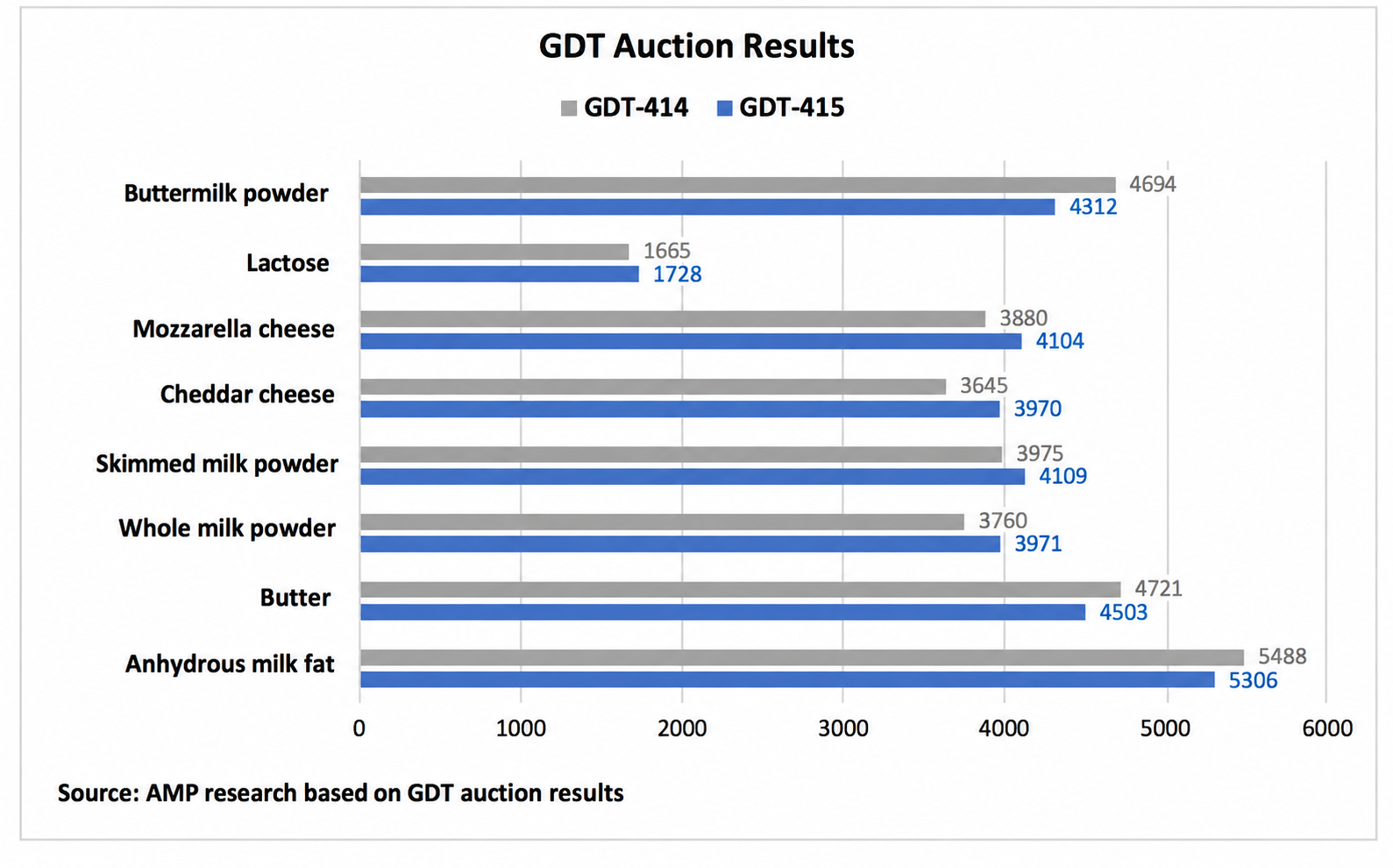
Following the auction, the price for Anhydrous Milk Fat (AMF) dropped to $5,306/MT, down 3.2% from the previous event. According to the Commodity Board, a global oversupply of dairy fat continues to weigh on prices. GDT forecasts suggest AMF prices could decrease by 4.0% in December and by 3.8% in January.
The price for butter at this auction reached $4,503/MT, down 4.7% compared to the previous event. According to Expana Markets, US butter prices declined despite improving demand due to increased production in previous periods, higher milk fat content in raw milk, and stable export demand. However, domestic butter demand in the US is being tempered by the growing popularity of GLP-1 weight-loss medications, which emphasize higher protein intake in daily diets. USDA data indicates that US butter stocks remain higher than during the same period last year, while domestic demand remains steady and is gradually recovering. Dairy processors are currently packing bulk butter blocks into retail packages in preparation for the upcoming holiday sales season.
The Commodity Board reports that EU butter prices remained stable week-on-week due to sluggish demand for dairy fats and persistent market oversupply. Processors are actively selling off butter at lower prices under contracts scheduled for Q1 and Q2 2027 delivery. Expana Markets notes that EU butter prices currently sit 37% below average 2025 levels.Nevertheless, according to Czapp, New Zealand co-op Fonterra has managed to maintain firm butter prices supported by demand from China, though not all buyers are accepting these price quotes. Event organizers project butter prices to fall by 5.1% in December and by 6.1% in January during the holiday season market lull.
The price for Whole Milk Powder (WMP) reached $3,971/MT, increasing by 5.9% compared to the previous auction.New Zealand co-op Fonterra revised its projected farm-gate milk price upward due to robust demand for WMP from Southeast Asia, the Middle East, Africa, and China. Chinese buyers are procuring large volumes of WMP against shrinking domestic inventories ahead of the Lunar New Year. At the start of the new production season, New Zealand has significantly boosted milk yields, directing surplus raw milk into WMP production and accumulating stocks to hedge against potential dairy sector risks posed by the developing El Niño phenomenon.
According to Czapp, Algeria is absorbing substantial volumes of WMP. The Algerian procurement agency ONIL purchased approximately 25,000 MT of WMP during its latest tender, with 21,000 MT sourced from New Zealand.Expana Markets reports that European firms face stiff competition from Russia and Belarus in the Algerian WMP market.Meanwhile, USDA data shows US WMP prices softened last week amid slowing spot market activity.
According to a forecast by the Rosario Board of Trade, Argentina could expand its WMP exports by 34,000 MT by 2035,leveraged by relatively low production costs, available processing capacity, and high output volumes. Argentina’s share of global WMP exports could reach 6%. This increased output from Argentina is likely to intensify export market competition for European producers who face higher manufacturing costs. Auction organizers forecast WMP price increases of 5.5% in December and 6.7% in January.
The price for Skimmed Milk Powder (SMP) rose to $4,109/MT, up 3.1% from the previous event. The Commodity Board reports that European SMP prices edged higher, driven by protein demand from the regional food processing industry as well as export markets. Strong demand for New Zealand SMP persists across Southeast Asia, the Middle East,Africa, and China. USDA data shows US SMP prices eased amid slower purchasing from Mexico and buyer resistance to higher price points. GDT forecasts indicate SMP could appreciate by 1.0% in December and 3.7% in January.
Cheddar cheese surged to $3,970/MT (+8.6%), while Mozzarella cheese increased to $4,104/MT (+5.8%). According to the USDA, EU cheese production is contracting amid seasonal milk yield declines, compounded by raw milk delivery disruptions to processing plants and delayed retail shipments due to rising fuel costs. Associated Press reports that Italian Buffalo Mozzarella production suffered the most severe impact, as it depends on a tightly scheduled raw milk delivery pipeline. Buffalo milk cannot be stored for long periods, and technical specifications require processing into Mozzarella within 60 hours.
Czapp reports that substantial Cheddar inventories persist in the US, as domestic processors had increased plant utilization to extract more whey for lucrative whey protein products. This resulted in excess cheese stocks and previously depressed Cheddar prices. However, US cheese demand is gradually recovering ahead of Thanksgiving and the holiday season, particularly for Mozzarella. Low-priced US Cheddar remains attractive on export markets; even New Zealand buyers have contracted US cheese at favorable prices, despite declining domestic Cheddar prices caused by higher local milk yields. Event organizers expect Cheddar prices to dip by 0.5% in November before rallying 12% in January, while Mozzarella is projected to gain 6% in January.
Lactose increased to $1,728/MT (+3.3%). USDA data shows lactose prices reached historic highs last week, significantly outperforming levels from the same period last year. Demand for lactose remains robust while inventories remain tight.GDT forecasts suggest lactose prices could gain 3.3% in January.
Buttermilk Powder (BMP) dropped to $4,312/MT (-4.4%). According to the USDA, demand for BMP remains stable while buyers await price adjustments. Processors remain focused on fulfilling existing contracts. Due to stronger demand for SMP, processors are prioritizing raw milk allocation toward SMP production. Auction organizers expect BMP prices to decline by 0.3% in December and by 4.3% in January.
The next GDT auction is scheduled for November 17.
Press service of the Association of Milk Producers
Follow us on LinkedIn
Related News