




According to Rabobank data, the global dairy market is transitioning from a period of significant growth in raw milk production to greater uncertainty regarding its supply. It is expected that the growth rate of production in the world's dairy regions may decline in the fourth quarter of 2026, and in the first half of 2027 it will remain stable. Raw milk production growth will likely continue in the US and Australia, but at a more moderate pace. The El Niño weather phenomenon creates a risk of reduced raw milk production in New Zealand and South America. Milk powder and dairy proteins remain the most resilient segments of the exchange-traded dairy complex thanks to the growing popularity of GLP-1 drugs, stable demand from Asian countries, and signs of market stabilization in China. Milk fat markets remain sufficiently supplied.
Production and Demand
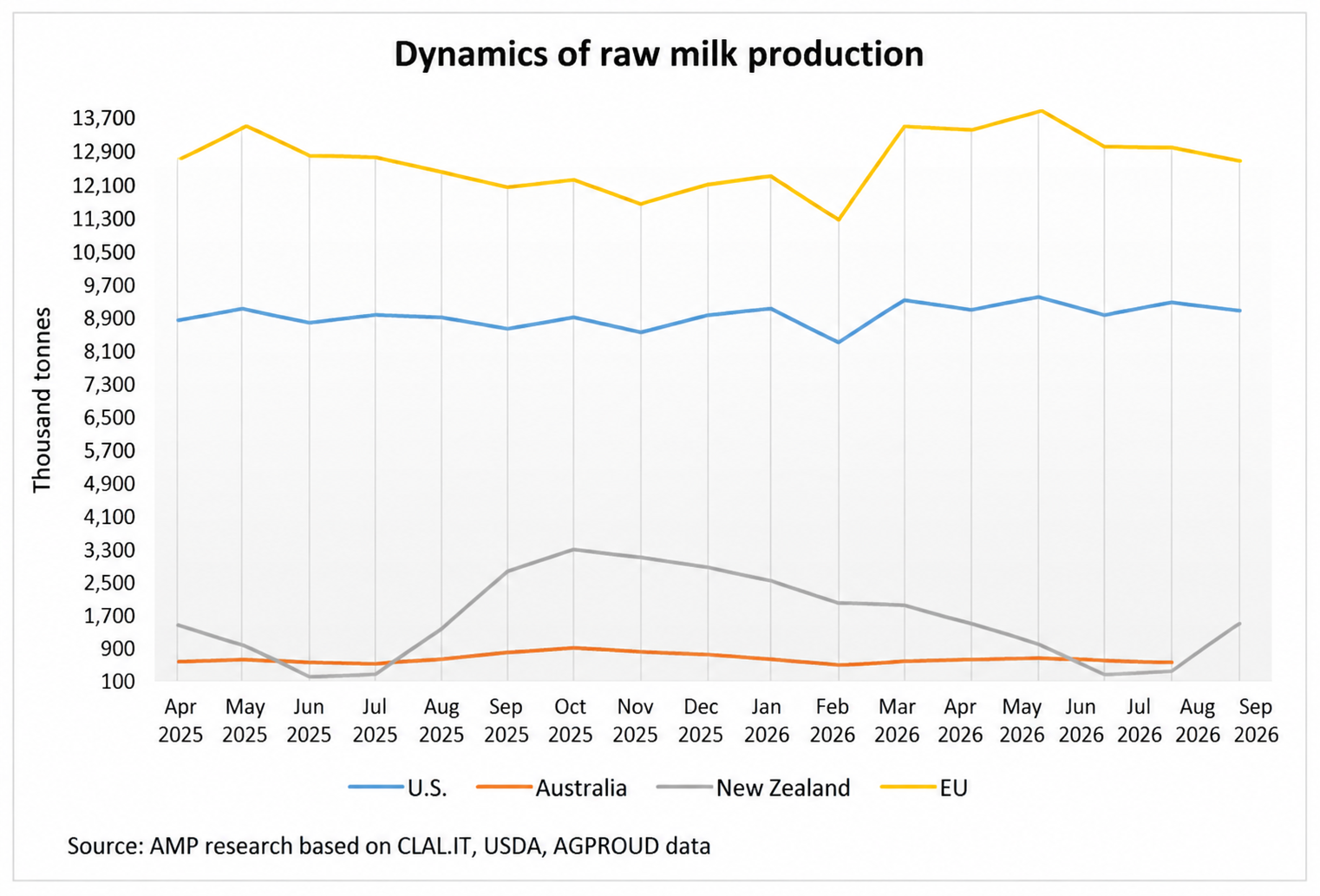
Europe. According to clal.it data, in August 2026, raw milk production in the EU stood at 12.66 million tons, which is 1.9% less relative to July, but 2% more relative to August 2025. In January–August 2026, the US produced 103.35 million tons, which is 3.1% more compared to last year's period. According to FAO data, raw milk production volumes in Europe are seasonally declining, and the milk fat supply remains limited after a hot and dry summer. Droughts and heatwaves negatively affected dairy cattle farming and led to a reduction in pastures, milk yields, and production volumes of traditional dairy products, particularly cheeses.
In particular, as USDA reports, the first reduction in raw milk deliveries for processing in several years was recorded in Poland. In France, in July, drought covered about 95% of the mainland territory, causing pastures to dry up and producers to face feed shortages. The French government was forced to temporarily relax production rules for some traditional cheeses due to the consequences of the heat. In Great Britain, five severe heatwaves and prolonged dry spells degraded pasture conditions in England and Wales, reduced yields, and caused heat stress in animals. However, raw milk production growth still continued in certain Western European countries.
As USDA reports, European dairy producers are calling on the EU for changes in agricultural policy due to concerns about deteriorating profitability and the risk of recurring periods of excess milk supply. Industry representatives advocate for earlier state intervention in the market, strengthening the bargaining position of producers, and raw milk price formation taking into account actual production costs. They also call for the introduction of production standards for imported dairy products similar to those in force in the EU.
According to AHDB data, a slowdown in EU milk production growth is expected in the second half of 2026, but the supply of finished products may remain significant due to a high production base in previous months. In the future, supply volumes of raw milk and dairy products in Europe will depend on demand in domestic and export markets, the international security situation, weather conditions, and disease outbreaks.
USA. According to clal.it data, in August 2026, raw milk production volumes in the US stood at 9.02 million tons, which is 1% less relative to July and 2% more relative to August 2025. In January–August 2026, the US produced 72.06 million tons, which is 2.6% more compared to last year's period. According to USDA data, the raw milk supply in the US mostly remains high, but seasonal temperature drops are gradually changing production conditions. American cheese producers report stable orders and high sales volumes. The supply of cream is sufficient on the spot market, which contributes to active butter production. Certain volumes of cream are even exported across the southern border to Mexico.
According to the Markets and Markets forecast, the US dairy market volume may grow to 343.7 billion US dollars by 2034. An increase in raw milk production in 2026 compared to 2025 is expected. Milk yield growth is facilitated by an increase in cow productivity due to improvements in genetics, feeding, and herd management. At the end of 2025, the dairy cow herd in the US reached nearly 9.5 million head, allowing the industry to increase production even without a significant increase in herd numbers.
Exports remain an important channel for disposing of American milk surpluses. In 2026, export volumes are expected to stand at about 7.94 million tons. Skimmed milk powder exports may remain stable, as an increasingly large part of raw materials is reoriented toward the production of high-protein dairy products, demand for which is growing among American consumers.
At the same time, the American dairy industry faces challenges such as rising costs for feed, fertilizers, labor, and other resources, which complicates the work of small farms and contributes to further production concentration. As of 2022, farms with a herd of 2,500 cows or more accounted for about 45% of all milk sales in the US. Consolidation occurs not only among producers, but also among dairy cooperatives. Most farmers sell milk through cooperatives, but their number in the US decreased from over 1,900 in 1952 to 107 in 2023. According to Food and Water Watch data, the three largest cooperatives — Dairy Farmers of America, Land O’Lakes, and California Dairies — ensure the sale of about 83% of milk in the US.
Oceania. According to clal.it data, in August 2026, milk production in New Zealand stood at 1.47 million tons, which is 3.4% more relative to July and 2.4% more relative to August 2025. In January–August 2026, New Zealand produced 10.99 million tons of raw milk, which is 5% more relative to last year's period. According to USDA data, the New Zealand dairy sector enters the new production season in a relatively strong position. High procurement prices over the two previous seasons gave farmers the opportunity to increase cow numbers, increase feed use in the winter period, and contribute to a more favorable calving period. A record conception rate during the first six weeks of the mating season created preconditions for milk production growth in the 2026/2027 season.
At the same time, weather conditions may lead to an earlier end of lactation, and forecasts regarding spring milk production growth may be adjusted. The Fonterra cooperative warned that the El Niño weather phenomenon could jeopardize raw milk production growth in the short term. El Niño is associated with a periodic rise in surface water temperatures in the eastern Pacific Ocean due to weakening trade winds and can cause droughts, heavy precipitation, and other extreme weather events that affect pasture conditions and feed availability.
According to DairyNZ estimates, in the event of a strong manifestation of El Niño, national milk production could contract by 2.1%, and if the negative impact is very severe, milk yield volumes could drop by 3.3%. Weather cataclysms could significantly increase farmers' costs and the break-even milk price level from a base of 8.62 to 8.90–9.07 New Zealand dollars per kilogram of milk solids. For North Island farms, which are more dependent on rainfall and purchased feed, the break-even level could rise to 9.41–9.56 New Zealand dollars per kilogram of milk solids.
As a result of El Niño, farmers' feed costs could increase from 1.56 to 2.02 New Zealand dollars per kilogram of milk solids. Farmers will likely have to increase feed purchases and adjust herd management. High feed, fertilizer, and operational costs may persist into the 2027/2028 season, limiting margins even with a raw milk procurement price of around 9.50 New Zealand dollars per kilogram of milk solids.
At the same time, Fonterra plans to invest 567.1 million US dollars over the next three years in expanding protein product production at a plant on the South Island, which should strengthen the cooperative's position in the value-added product segment. According to USDA data, in August 2026, the export value of New Zealand milk powder, butter, and cheese stood at 1.2 billion US dollars, which is 7.6% more than in August 2025. Shipments of milk powder, butter, and cheese to China, as well as casein and caseinates to the EU, increased.
In Australia, in August 2026, aggregate production input costs fell for the fourth consecutive month due to cheaper feed. Stable precipitation improved grain supply prospects in southern regions. Weaker demand for feed in Australia's southern states, where sufficient rainfall contributed to active pasture and crop growth, facilitated cheaper feed. In August, feed in Australia cost less than last year. However, drought in the states of New South Wales and Queensland supported demand for feed and restrained a larger price drop.
Despite the Bureau of Meteorology's forecast of warmer weather due to El Niño formation, its impact was barely evident during August, as evidenced by lower feed prices. However, diesel fuel prices rose by 21% compared to July, partially offsetting the lower cost of most other production inputs. Water point usage fees dropped thanks to an increase in available water volumes and improved reservoir storage levels.
 Dairy Market Prices
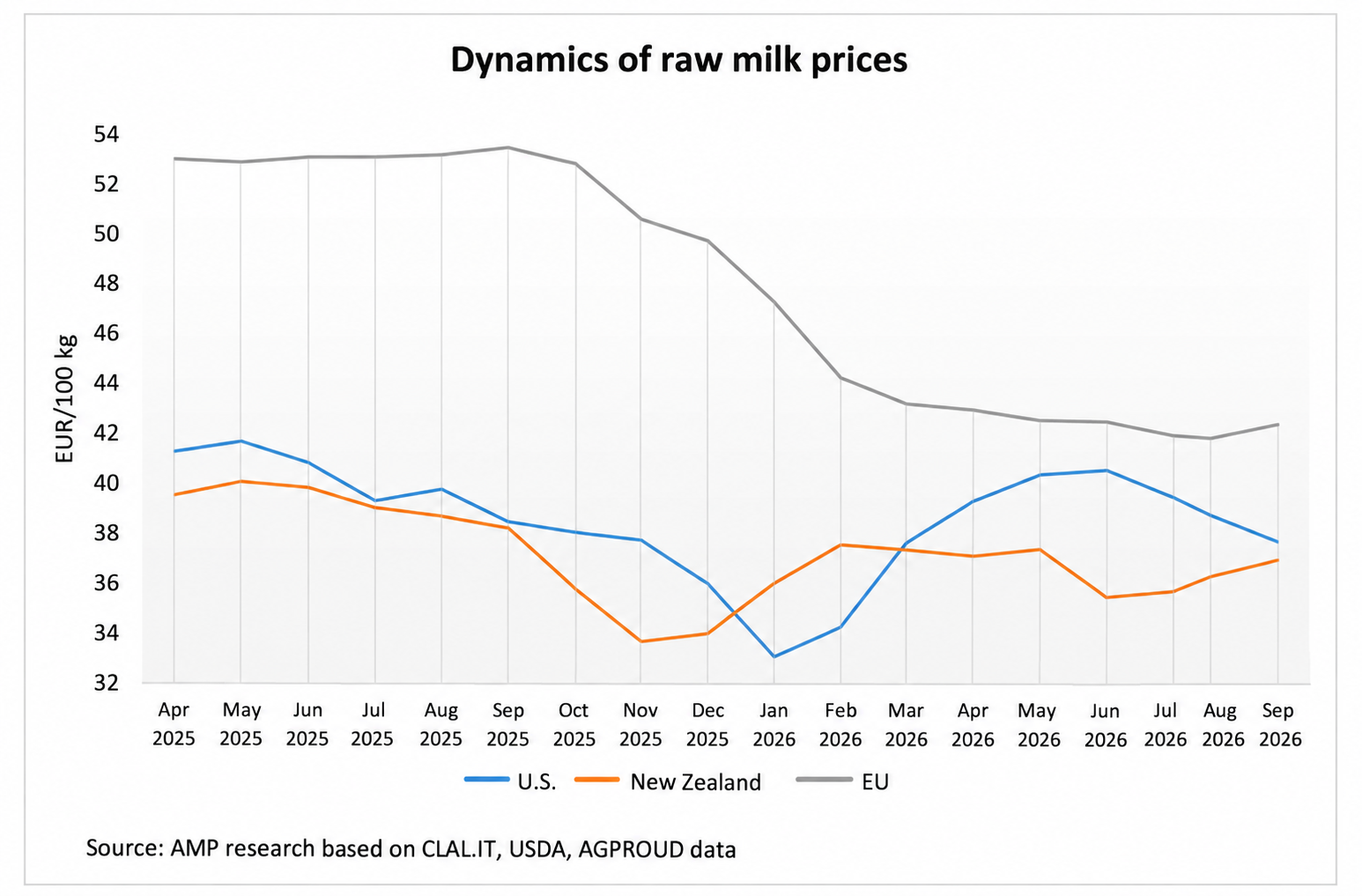
Europe. According to preliminary European Commission data, in August 2026, the average raw milk price in the EU stood at 42.22 euro cents per kg, which is 0.40% more than in July 2026. Relative to the price as of August 2025, milk in the EU depreciated by 20.64%. Strengthening butter and milk powder markets supports raw milk procurement price growth in Europe. Price increases were affected by a slowdown in milk yield volumes under the influence of unfavorable weather. As IFCN reports, at the end of August air temperatures decreased somewhat in Europe, but dry weather during previous weeks negatively affected the production of protein feeds, particularly rapeseed and sunflower. Grass and agricultural crops grew slower, and their quality deteriorated. Some farmers were forced to harvest feed and crops earlier to avoid losing them due to further drought. The feed supply this year may be smaller, and its nutritional value lower.
USA. According to clal.it data, in August 2026, the milk price in the US stood at 37.65 euro cents per kg, which is 3.94% less relative to July and 4.95% less relative to August 2025. Significant raw milk supply, warehouse stocks of butter and cheese, as well as sluggish domestic market demand put pressure on procurement prices in the US.
Oceania. According to clal.it data, in August 2026, the raw milk price in New Zealand stood at 36.79 euro cents per kg, which is 3.46% more relative to June, but 4.54% less than in August 2025. The weakening of the New Zealand dollar, the exchange rate of which holds below the 57 US cents mark, supported domestic profitability amid falling international exchange-traded dairy commodity prices. This allowed maintaining the base benchmark for the raw milk procurement price for the current production season at the level of 9.50 New Zealand dollars per kilogram of milk solids.
Follow us on LinkedIn
Related News