




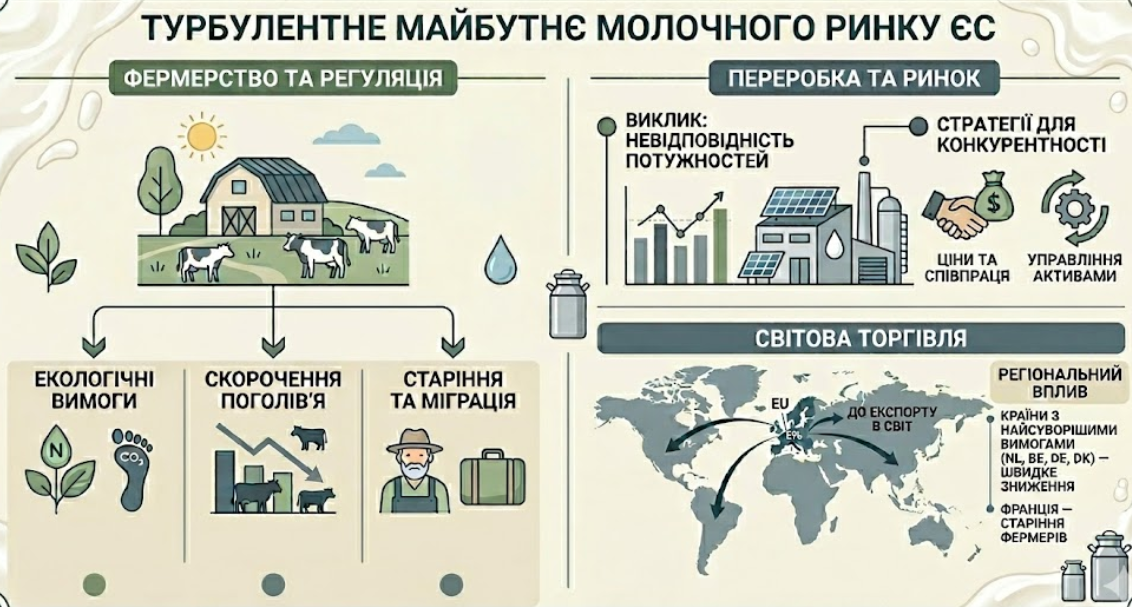
The milk supply situation in the EU is changing. The primary reason is the stabilization of production, with a decline even expected in the medium term. After the abolition of the quota system that regulated milk production in Europe, restrictions effectively vanished, and production grew rapidly, especially in North-Western Europe. According to Rabobank, a reduction in milk production volumes is expected in North-Western Europe over the next 5–10 years. This decline poses challenges for processors who, following the abolition of quotas, invested significant capital into expanding capacities, counting on the continued growth of milk yields. While production did indeed grow between 2015 and 2020, under conditions of further contraction, a portion of processing capacities may remain underutilized.
One of the main reasons for the reduction of the dairy pool in Europe is EU regulatory policy. Strict environmental requirements regarding nitrogen, phosphate, and carbon emissions are in effect. Tightening rules for manure disposal and permit acquisition limits expansion opportunities and raises costs for farmers. An additional factor is the aging of farmers. Some regions of Europe are also experiencing population decline. Eastern Europe faces a labor shortage due to migration to Western EU countries. For example, Bulgaria has lost 20% of its population since 2000, which impacts labor availability and the viability of the dairy sector.
The largest reductions in milk production are expected in countries with the most stringent requirements for farmers. These are the same countries that previously demonstrated the fastest growth after quotas were lifted. Together, the Netherlands, Belgium, Germany, and Denmark account for 35–40% of total milk production in Europe. A production decline is also projected in France, though primarily due to the aging farmer population.
The decrease in milk volumes may affect processing enterprises, which must change their approach to cooperating with milk producers. To remain competitive, processors must take two key steps. First, build strong relationships with farmers and offer competitive milk prices. Second, efficiently manage their production assets to maintain sufficient plant utilization levels amid shrinking raw milk supply, as utilization is a critical factor in maintaining the cost efficiency of dairy product manufacturing.
Global milk supply is expected to decrease by 5% over the next 10 years. At first glance, this may not seem like much, but a significant portion of European dairy products is exported. Under conditions of stable demand and decreasing milk supply, less finished product will remain available for export. If milk production drops by 5%, the EU will have 40% less milk equivalent available for export to the rest of the world. This niche could be filled by producers from other regions.
Experts note that this is a long-term scenario and the situation may change. However, current trends point toward a steady structural reduction of the dairy pool in Europe, which will create new opportunities for other exporters and impact the global commodity market.
Source: https://www.dairyglobal.net/
Press service of the Association of Milk Producers
Follow us on LinkedIn
Related News