





In the first quarter of 2026, the cow population in Ukraine declined not only in private households but also on industrial farms.
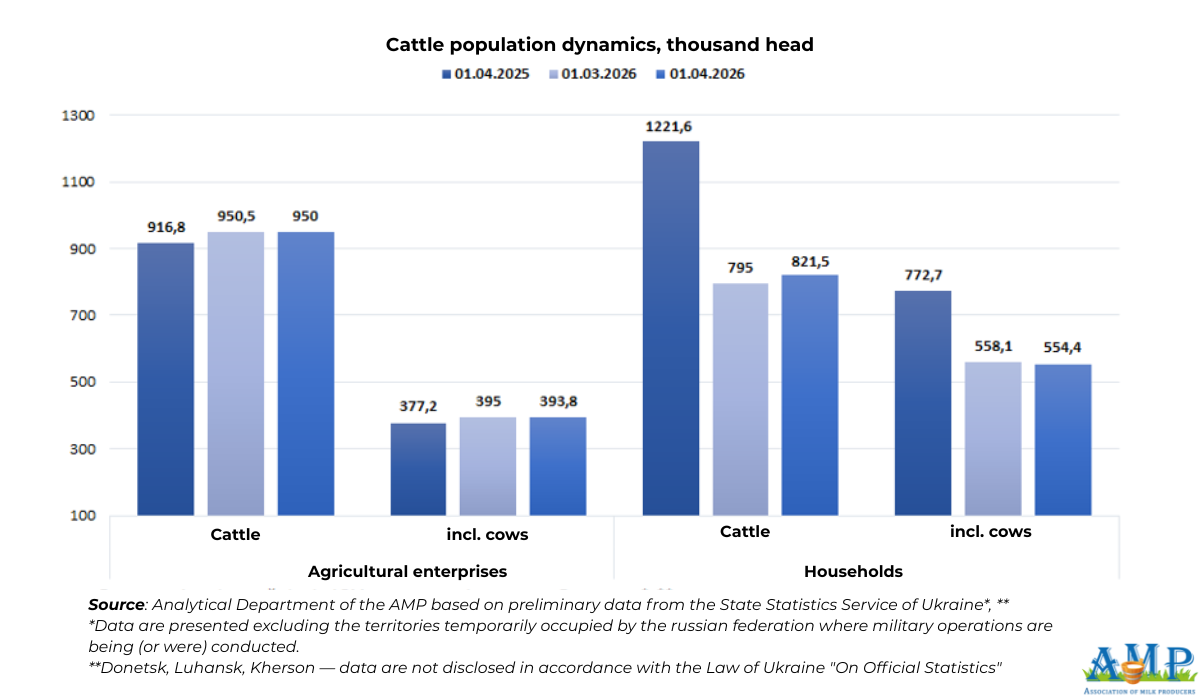
According to preliminary data from the State Statistics Service, as of April 1, 2026, there are 1,771.1 thousand head of cattle in the household and industrial sectors of Ukraine, including 948.2 thousand cows. Compared to March 1, 2026, the number of cows decreased by 4.9 thousand head (-1%). Compared to April 1, 2025, the cattle population decreased by 367 thousand head (-17%), including cows by 202 thousand head (-18%). About 54% of the animals are kept at industrial enterprises, and 46% in households.
In the industrial sector, there are 949.6 thousand head of cattle, which is 1 thousand head less (-0.1%) compared to March 1, 2026. The cow population stands at 393.8 thousand head and decreased by 1.2 thousand head (-0.3%) over the last month. For reference, in 2025, the cattle population at enterprises increased by 32.8 thousand head (+4%), and the number of cows increased by 16.6 thousand head (+4%).
The number of cows in households as of April 1, 2026, was 554.4 thousand head, which is 4 thousand head less (-1%) than a month ago. Over the last year, the number of cattle in households decreased by 400 thousand head (-33%), while the number of cows decreased by 218 thousand head (-28%).
For the second consecutive month, the cow population is shrinking not only in the household sector but also on industrial dairy farms. The pressure of rising production costs and low purchase prices—levels of which, for some farms, do not even cover the cost of raw milk production—is straining producers. Furthermore, a sharp reduction in livestock continues at agricultural enterprises in the east and south of the country due to Russian aggression. These farms are forced to relocate cows to safer regions in Central and Western Ukraine. In March, Ukraine did not import any heifers. Farmers have taken a "wait-and-see" approach amidst unfavorable market conditions.
The surge in prices for oil, petroleum products, and natural gas, along with the reduction of ammonia and urea supplies from the Persian Gulf to the global market following the U.S. and Israeli military operation against Iran, has led to rising fertilizer prices, more expensive logistics, and increased production costs under conditions of weak domestic demand for dairy products. In the future, a further increase in farmers' feeding costs is likely due to the rising cost of grain and oilseeds, which, given the current level of raw milk prices, could lead to an even greater reduction in the herd.
The problem of modernizing old farms remains urgent. There are 1,375 dairy farms in Ukraine, of which about 850 (60%) require reconstruction and investment to meet European animal welfare standards. Their modernization could cost between 500–1,200 EUR per cow, depending on the condition of the facilities and the housing and milking technologies used. The total investment volume could reach approximately 219 million EUR. The highest costs fall on older enterprises with populations ranging from 100 to 500 cows. Large milk producers are independently investing in the reconstruction of premises, the implementation of modern ventilation and lighting systems, and ensuring comfortable housing conditions for the animals.
In the regional breakdown, about 53% of the total cattle population is kept in households of all categories in the following regions:
- Poltava region – 164.90 thousand head;
- Vinnytsia region – 155.00 thousand head;
- Khmelnytskyi region – 144.40 thousand head;
- Chernihiv region – 125.70 thousand head;
- Odesa region – 125.00 thousand head;
- Cherkasy region – 124.90 thousand head;
- Kyiv region – 102.70 thousand head.
Press service of the Association of Milk Producers
Follow us on LinkedIn
Related News