





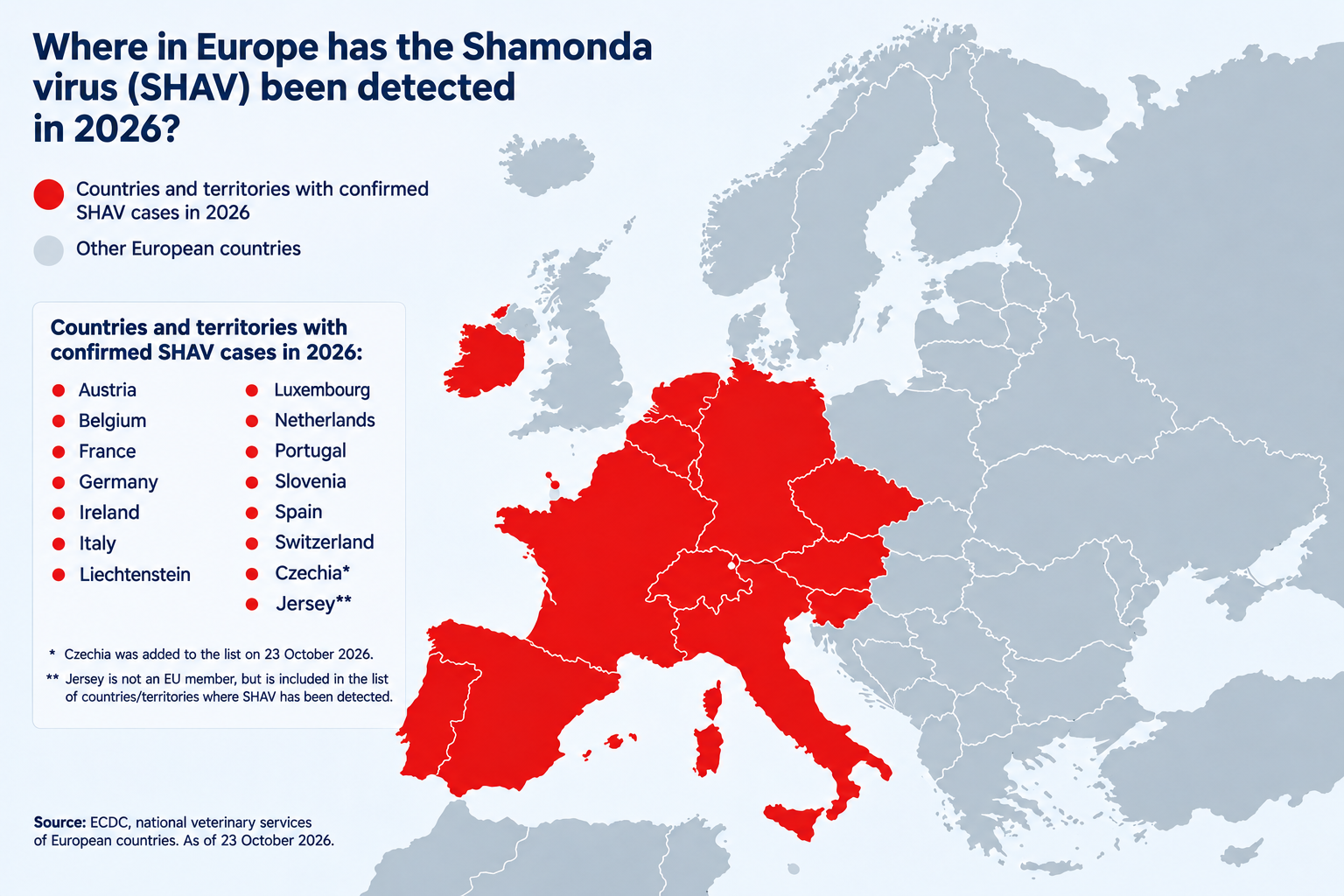
Europe is facing a new epizootic threat to the continent—the Shamonda virus (SHAV).
In the summer of 2026, the virus was detected among farm animals in Central Europe for the first time. Since then, it has continued to spread, and on October 23, 2026, the Czech Republic confirmed its first case after the virus was identified in an aborted bovine fetus at a farm in the Tábor district.
According to ECDC data, as of October 22, SHAV had already been detected in animals across Austria, Belgium, France,Germany, Ireland, Italy, Liechtenstein, Luxembourg, the Netherlands, Portugal, Spain, Switzerland, and Jersey. Following the confirmed case in the Czech Republic, the geographical spread now spans 14 European countries and territories.
How Did the Virus Reach Europe?
The Shamonda virus has been known to science since 1965, when it was first isolated from cattle in Nigeria. In subsequent decades, it was detected primarily in Africa and Asia, notably in Japan.
SHAV was first recorded in Europe in the summer of 2026. According to Germany’s Friedrich-Loeffler-Institut (FLI), the initial European cases were linked to southern Germany, Switzerland, and France. However, the exact timing and mechanism of the virus's introduction into Europe remain undetermined.
Importantly, the European situation has proven genetically heterogeneous: in 2026, two distinct European genetic variants were identified—SHAV-EU1 and SHAV-EU2.
Germany
The FLI reports the spread of SHAV across various federal states. By August, the virus had already been confirmed in Baden-Württemberg, Hesse, Bavaria, Saarland, and Saxony, as well as in a horse and an alpaca. At the same time,determining the exact scale of the spread in Germany is difficult because the disease is not notifiable.
France
In France, the virus has been detected in cattle farms exhibiting clinical signs such as fever, drops in milk yield, and reproductive disorders. Official French and Spanish veterinary documents also record the circulation of both European SHAV variants.
Spain
The Spanish Ministry of Agriculture reports the confirmation of SHAV Type 1 and Type 2 in dairy and beef cattle herds.Affected animals displayed fever, diarrhea, and reduced milk productivity.
Overall, official Spanish data already includes Austria, Belgium, Slovenia, Ireland, Italy, Liechtenstein, the Netherlands,Portugal, France, Germany, Switzerland, and Jersey among territories with confirmed cases.
How Does SHAV Spread?
The virus is transmitted primarily through the bites of blood-sucking midges of the genus Culicoides.
Direct horizontal transmission between animals has not been confirmed to date. However, vertical transmission from mother to fetus has been described, which is of particular significance for pregnant animals.
Consequently, the spread of SHAV largely depends on vector activity and weather conditions.
What Are the Implications for Dairy Farms?
In adult cattle, the infection can manifest as:
- fever;
- diarrhea;
- reduced milk productivity;
- abortions;
- stillbirths;
- congenital fetal malformations.
According to the Spanish Ministry of Agriculture, milk yields in some affected farms dropped by over 20% within 7 to 10 days, although the actual disease progression may vary between farms.
At the same time, the WOAH emphasizes that the long-term impact of the European SHAV variants cannot yet be reliably assessed. The consequences of infection in immunologically naïve pregnant animals remain a critical concern.
SHAV Requires Laboratory Confirmation
Clinical signs of infection are non-specific, making it impossible to diagnose SHAV based on symptoms alone.
The WOAH recommends laboratory diagnostics, which may include:
- pan-Simbu PCR;
- specific RT-PCR;
- sequencing;
- serological testing and serum neutralization to differentiate from other Simbu group viruses.
Suitable samples include blood/serum from animals in the acute phase, and in cases of abortion or stillbirth, fetal brain and spleen tissues.
This is particularly crucial because SHAV is closely related to the Schmallenberg virus (SBV) and other Simbu group viruses, and serological reactions between them can cross-react. Spanish veterinary authorities recommend using specific serum neutralization for confirmation.
Is SHAV a Quarantinable Disease in the EU?
To date—no.
Because SHAV was first recorded in the EU in the summer of 2026, the infection is not currently included in the list of EU diseases under Regulation (EU) 2018/1882. Therefore, its detection does not automatically trigger an EU-wide quarantine or eradication regime.
Similarly, SHAV is not a notifiable disease to the WOAH. Nevertheless, the WOAH encourages countries to voluntarily report cases in accordance with Article 1.1.5 of the Terrestrial Animal Health Code to improve monitoring of the virus's spread and epidemiology.
This creates an important nuance: the officially confirmed number of cases may not reflect the actual scale of virus circulation.
The Example of the Czech Republic
Following the spread of SHAV in Europe, the Czech Republic introduced mandatory testing for the virus effective October 1, 2026, in cases of:
- bovine abortions;
- birth of calves with malformations;
- stillbirths or the birth of non-viable calves.
On October 23, it was precisely thanks to this monitoring that the first case of SHAV was confirmed in the country.
The Czech veterinary service also recommends that in the presence of acute clinical signs, particularly fever and drops in milk yield, animals should be considered for laboratory testing for SHAV, and animal movements from the farm should be restricted during the period of clinical manifestations.
Does SHAV Pose a Threat to Humans?
This question is currently under investigation.
On October 22, the ECDC reported the first documented case of human infection with SHAV in France. The patient had a severe underlying condition accompanied by significant immunodeficiency and passed away in early October.
At the same time, the ECDC emphasizes that this remains the only known case, and transmission routes and the virus's role in the patient's death are still being investigated. Person-to-person transmission has not been established.
The WOAH also notes that historically, SHAV has not been considered a cause of human disease, but its potential zoonotic role regarding European variants has not yet been sufficiently studied.
What Should Ukrainian Dairy Farms Do?
While there is no cause for panic, there are strong grounds to step up veterinary monitoring and biosecurity.
The AMP recommends that farms:
- pay special attention to sudden drops in milk yield, fever, and diarrhea;
- enhance monitoring of abortions, stillbirths, and congenital calf malformations;
- include SHAV in differential diagnostics alongside the Schmallenberg virus and other Simbu group infections in relevant cases;
- ensure timely collection and dispatch of samples to laboratories to confirm the diagnosis;
- strengthen control measures against blood-sucking insects—use physical barriers, reduce vector breeding sites,monitor their population numbers, and apply authorized veterinary treatments;
- closely monitor the epizootic situation in Central and Eastern European countries.
At the same time, it is important to remember that vector control measures reduce risk but cannot guarantee complete herd protection.
Conclusion
SHAV is a novel challenge for European livestock farming, the scale and long-term consequences of which are still being studied.
The primary task for Ukraine right now is not to wait for the first case to emerge, but to prepare an early detection system.
The AMP continues to monitor the situation and will promptly inform dairy farms of new data regarding the spread,laboratory diagnosis, and prevention of the Shamonda virus.
Biosecurity, early diagnosis, and vigilant veterinary monitoring are the best preparation for a new epizootic threat.
Official Sources
WOAH — Shamonda virus: official information and recommendations
ECDC — first documented human case of SHAV
Friedrich-Loeffler-Institut — current situation regarding SHAV in Germany
Státní veterinární správa ČR — first case of SHAV in the Czech Republic
Spanish Ministry of Agriculture — official information on SHAV
Press service of the Association of Milk Producers
Follow us on LinkedIn
Related News