





In July, raw milk production was restrained by severe heat and growing costs of farmers.
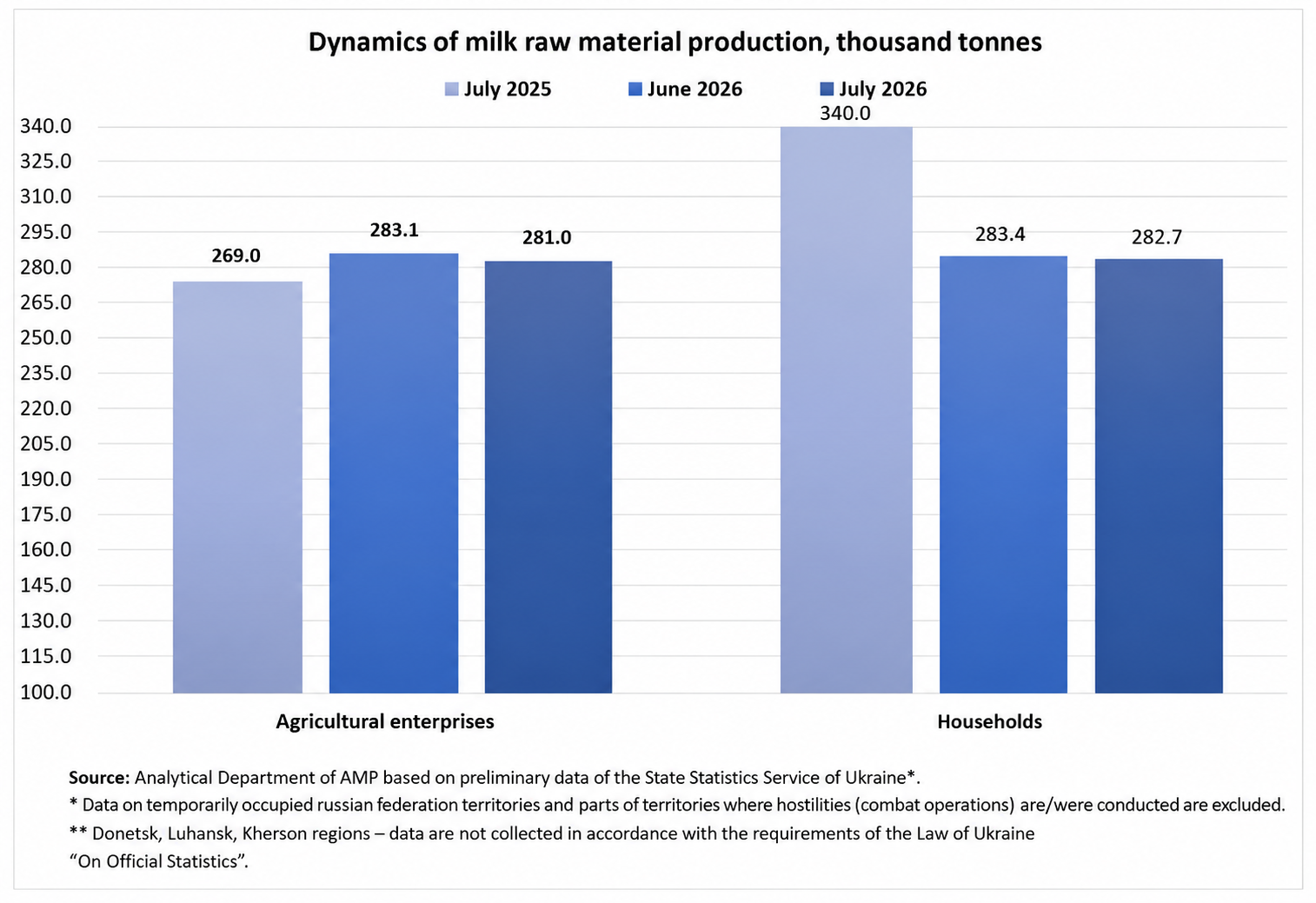
According to preliminary data from the State Statistics Service, in July 2026 holdings of all categories produced 563.70 thousand tons of raw milk, which is 2.8 thousand tons less (-0.5%) relative to June and 99.7 thousand tons less (-15%) relative to July 2025. In January–July 2026, Ukraine produced 3.55 million tons of raw milk, which is 499 thousand tons less (-12%) relative to last year's period. In January–July 2026, the share of enterprises in raw milk production stood at 54%, and of household holdings – 46%.
Enterprises produced 281 thousand tons of raw milk in July 2026, which is 2.1 thousand tons less (-0.7%) compared to June, but 12 thousand tons more (+4.5%) relative to July 2025. In January–July 2026, commercial dairy farms produced 1.93 million tons of raw milk, which is 97.3 thousand tons more (+5%) relative to last year's period. At the same time, cattle slaughter volumes at enterprises in July stood at 10.63 thousand tons (live weight), which is 2% more relative to June, but 5% less relative to July 2025. Since the beginning of the year, cattle slaughter volumes stood at 79.24 thousand tons, which is 6% more than last year.
In household holdings, milk yield volumes in July 2026 stood at 282.70 thousand tons of raw milk, which is 700 tons less (-0.2%) relative to June and 111.7 thousand tons less (-28.3%) relative to July 2025. In January–July 2026, household holdings produced 1.62 million tons of raw milk, which is 596.3 thousand tons less (-27%) relative to last year's period.
In July, raw milk production in Ukraine was almost at the level of June and decreased insignificantly in the household and industrial sectors. However, milk yield volumes on commercial dairy farms (CDFs) even under conditions of force majeure circumstances that pressed on the dairy industry were still higher relative to July 2025. The same situation applies to milk production volumes on CDFs since the beginning of the year. In Ukraine, raw milk production volumes decreased under the influence of heat, as not all commercial dairy farms underwent modernization and are equipped with modern ventilation systems that allow cows to avoid heat stress. Hot weather affected the reduction of raw milk production in many holdings by 10–15%. As a result of the fall in milk yield volumes, certain holdings failed to fulfill plans for providing raw milk to milk processing enterprises.
Demand for raw milk from milk processing enterprises was restrained by a reduction in demand for whole milk products in the domestic market, a slowdown in butter export volumes to the EU, and an influx of imported cheeses into Ukraine. In the first half of 2026, 23 thousand tons of imported cheese were brought into Ukraine, which is 20% more than last year. In terms of raw milk, this amounts to about 250 thousand tons of raw milk that should have been used by Ukrainian cheesemakers to produce domestic products.
A reduction in raw milk production on CDFs is likely in the fourth quarter of 2026, as the prime cost of raw milk production is much higher than current procurement prices, which at best allow farmers to break even, and at worst are loss-making. Due to rising fuel prices, the costs of delivering raw milk to the plant increase, which presses on procurement prices. When calculating profitability, the price of raw milk is taken into account including the delivery cost to the milk processing enterprise. Despite a probable decrease in meal prices, the prime cost of roughage with huge prices for diesel fuel can be too high.
Also, prerequisites exist in Ukraine for the growth of feed prices. The fertilizer market enters a period of high prices and limited supply. Fertilizer volumes in the spot market remain minimal, and more expensive logistics affects the growth of delivery prime costs. In previous months, insufficient amounts of phosphate and NPKS fertilizers were imported, and domestic fertilizer production volumes do not allow for compensating the shortage. The combination of expensive logistics, limited supply, and accumulated demand creates prerequisites for further growth of fertilizer prices, and therefore greater costs for crop production, feed, and cow feeding.
A challenge for the dairy industry became Russian strikes on distribution centers of such key Ukrainian retail networks as Novus, Silpo, ATB, as well as on the accumulation center of the Danone company. Dairy products arrive at distribution centers from milk processing plants and are then delivered to individual stores. If a distribution center drops out of this supply chain, whole milk product order volumes for end supermarkets can decrease for almost a week. During periods of such logistical disruptions, surpluses of raw milk appear at milk processing enterprises, which can be directed to the production of butter, milk powder, or UHT milk, but not fresh dairy products, which will be difficult to quickly deliver to supermarkets without distribution centers. After resolving obstacles with delivering dairy products to the final consumer, a recovery of demand for raw milk from whole milk product producers is likely.
In January–July 2026, raw milk production volumes were increased by agricultural enterprises in 14 regions, namely in Vinnytsia region (+6%), Volyn region (+3%), Zhytomyr region (+13%), Ivano-Frankivsk region (+15%), Kyiv region (+2.8%), Kirovohrad region (+2%), Lviv region (+15%), Mykolaiv region (+4%), Rivne region (+36%), Ternopil region (+15%), Kharkiv region (+26%), Khmelnytskyi region (+2%), Cherkasy region (+4%), and Chernihiv region (+11%) relative to last year's period.
In January–July 2026, about 54% of raw milk was produced by agricultural enterprises in the following regions:
- Poltava region – 277.70 thousand tons;
- Cherkasy region – 234.90 thousand tons;
- Khmelnytskyi region – 183.70 thousand tons;
- Chernihiv region – 182.70 thousand tons;
- Vinnytsia region – 174.20 thousand tons.
Press service of the Association of Milk Producers
Follow us on LinkedIn
Related News