





Rising prime cost of raw milk production, low procurement prices, and the likelihood of higher prices for roughage force farmers to reduce the cow herd.
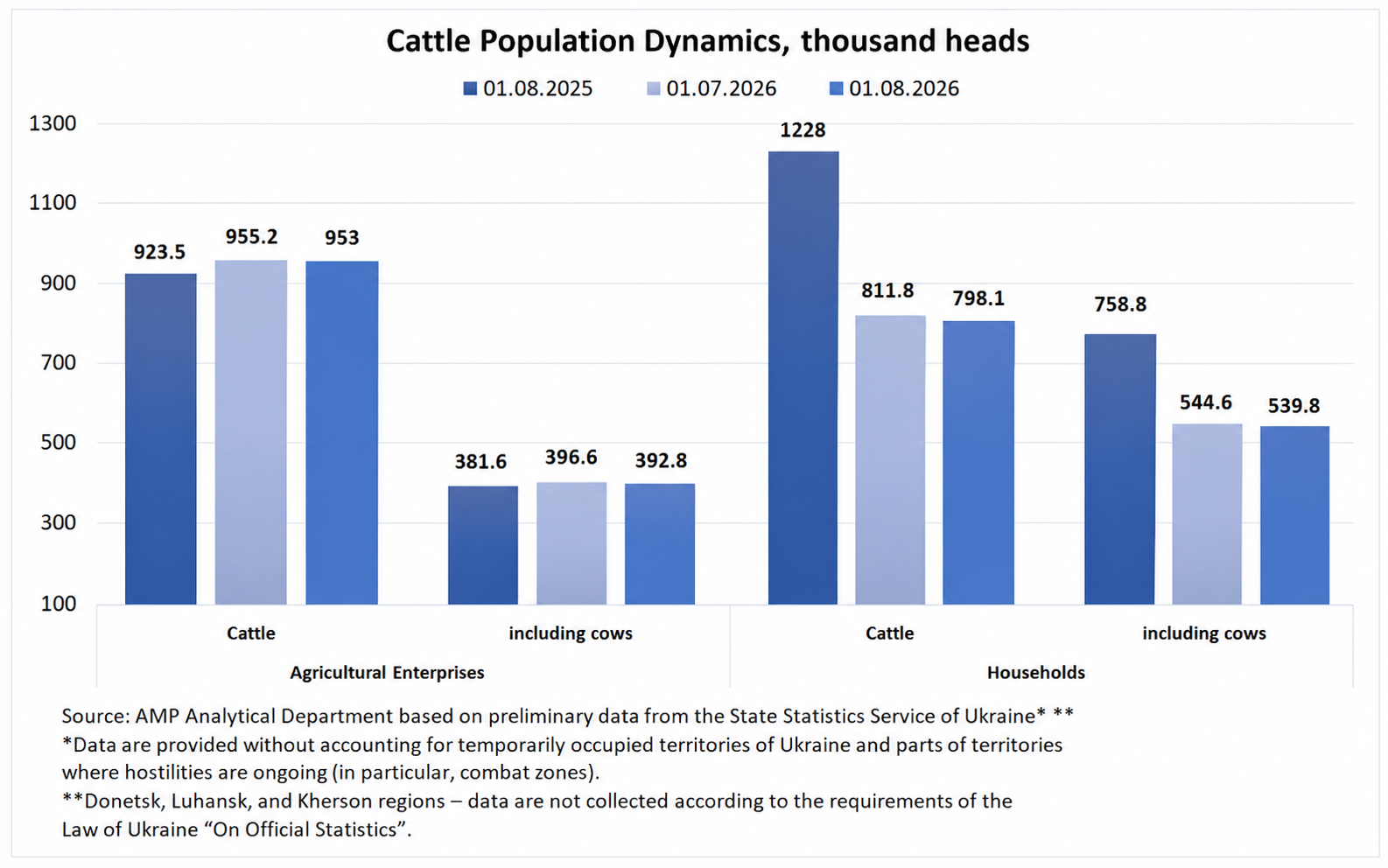
According to preliminary data from the State Statistics Service, as of August 1, 2026, 1 million 751.1 thousand head of cattle are kept in the household and industrial sectors of Ukraine, including 932.6 thousand cows. Compared to July 1, 2026, the cattle herd in Ukraine decreased by 15.9 thousand head (-0.9%), and the number of cows decreased by 8.6 thousand head (-0.9%). Relative to August 1, 2025, the cattle herd decreased by 400 thousand head (-19%), including cows – by 208 thousand head (-18%). About 54% of animals are kept at industrial enterprises, and 46% – in household holdings.
In the industrial sector, 953 thousand head of cattle are kept, which is 2 thousand head less (-0.2%) relative to July 1, 2026. The cow herd stands at 392.8 thousand head and decreased by 3.8 thousand head (-1%) over the last month. Over the last year, the cattle herd at enterprises increased by 29.5 thousand head (+3%), and the number of cows increased by 11.2 thousand head (+3%).
In the household sector, 798.1 thousand head of cattle are kept, which is 14 thousand head less (-1.7%) compared to July 1, 2026. The number of cows in household holdings as of August 1, 2026, stood at 539.8 thousand head, which is 5 thousand head less (-0.9%) than a month ago. Over the last year, the number of cattle in household holdings decreased by 430 thousand head (-35%), and the number of cows decreased by 219 thousand head (-29%).
According to preliminary data from the State Statistics Service, growth in the number of the cow herd was recorded at agricultural enterprises in 12 regions, namely in Vinnytsia region (+1%), Volyn region (+1%), Zhytomyr region (+8%), Kyiv region (+4%), Lviv region (+21%), Mykolaiv region (+3%), Rivne region (+28%), Ternopil region (+13%), Kharkiv region (+15%), Khmelnytskyi region (+7%), Cherkasy region (+4%), and Chernihiv region (+2%) relative to August 1 of last year.
In Ukraine, the reduction of the cattle herd continues, including cows, predominantly at the expense of the household sector. The industrial sector increased the cow herd since the beginning of the year relative to last year's period. However, farmers got rid of part of the cows in July. The reduction of the cattle herd is a long-standing problem for Ukraine due to the lack of an effective state support program for dairy cattle breeding. Since 2014, the cow herd in the industrial and household sectors of Ukraine has decreased almost three times. Russia's full-scale invasion worsened the situation. Agricultural enterprises from the frontline regions of the Southeast are forced to relocate the cow herd to safer regions of Central and Western Ukraine due to the threat of Russian strikes.
In Ukraine, a state support program for the construction and reconstruction of livestock complexes for keeping cattle is being implemented. The construction of livestock complexes is already being carried out by 31 enterprises that can potentially receive state compensation. After updating the conditions of the state program, compensation for the cost of construction and reconstruction of livestock farms was increased to 50% for agricultural producers who relocated their enterprises from frontline territories.
Farmers reduce the cow herd under the pressure of growing production costs. Due to rising fuel prices, the costs of delivering raw milk to the plant increase. The prime cost of roughage may increase due to high diesel fuel prices despite a probable decrease in meal prices. In Ukraine, there is a limited supply of fertilizers, which together with more expensive logistics creates prerequisites for further price growth. It is likely that feed production costs will rise, and cow feeding will become more expensive. It is not profitable for farmers to increase the cow herd, as the prime cost of raw milk production is much higher than current procurement prices, which at best allow farmers to break even, and at worst are loss-making.
If by 2035 domestic milk processing enterprises undergo no modernization and do not begin deeper processing of raw milk and buying it from farmers at higher prices, small and medium-sized farms, where about 40% of the entire herd is currently kept, may disappear from the market. Low raw milk prices and rising production costs prompt farmers to sell livestock for slaughter. According to preliminary data from the State Statistics Service, in January–July 2026, cattle slaughter volumes stood at 79.24 thousand tons, which is 6% more than last year. At the same time, in July, slaughter volumes in the industrial sector increased by 2% relative to June.
In the regional breakdown, about 60% of industrial sector cows are kept at commercial dairy farms in the following regions:
- Poltava region – 52.40 thousand head;
- Cherkasy region – 46.10 thousand head;
- Chernihiv region – 38.00 thousand head;
- Kyiv region – 35.40 thousand head;
- Khmelnytskyi region – 32.50 thousand head;
- Vinnytsia region – 32.50 thousand head.
Press service of the Association of Milk Producers
Follow us on LinkedIn
Related News