





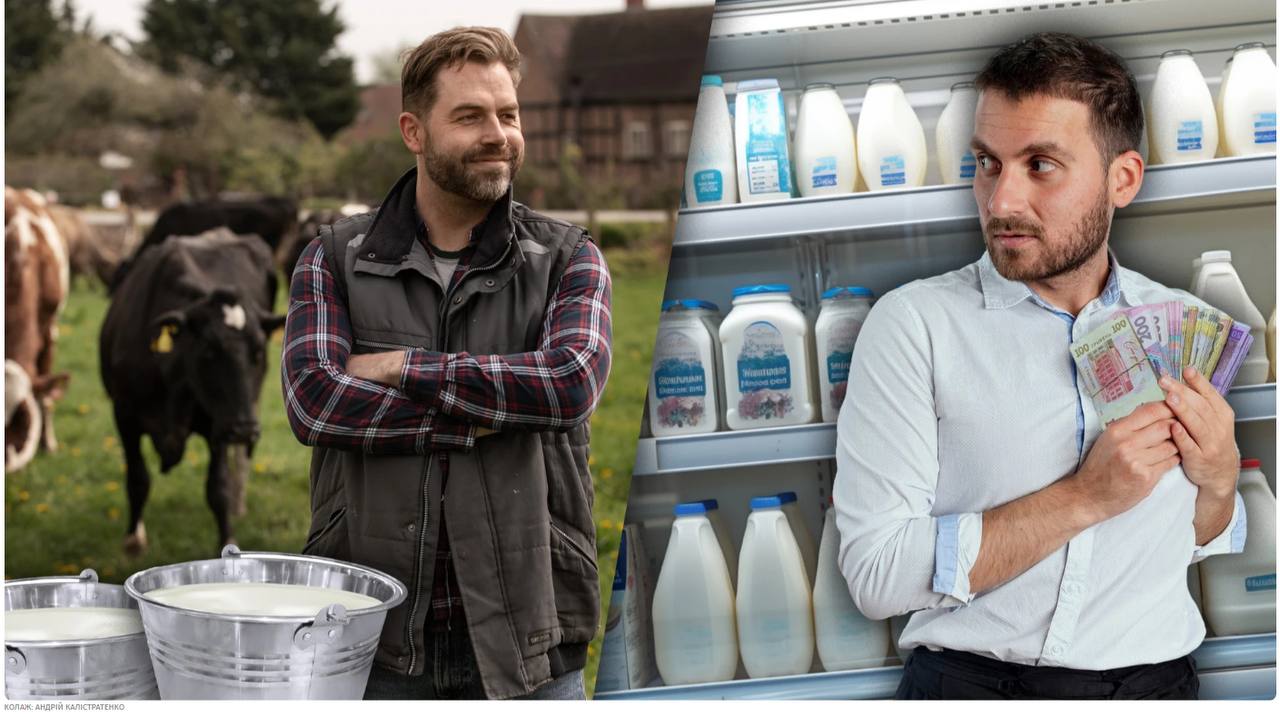
The price of farm milk in Ukraine has dropped significantly, yet dairy products on store shelves have not decreased in cost. Who is capturing the margin between the farm, the processing plant, and the supermarket, and why are retailers remaining silent? Ekonomichna Pravda (epravda.com.ua) breaks down the supply chain from the farm to the cash register.
In recent months, Ukrainian milk producers have faced a situation where selling raw materials means generating losses. Procurement prices have slumped to the point where some farms are already cutting costs and postponing development. If this trend persists, the market risks losing a portion of its cattle population and production capacity. At the same time, this has had no impact on the retail price of dairy products.
To understand where this difference is being absorbed, Ekonomichna Pravda consulted the main links in the dairy production chain: farmers, processors, and retailers. The former quickly shifted to a lobbying stance: "We are losing, others are to blame." Retailers, pointed to by both farms and processing plants as the primary beneficiaries of this structure, have once again chosen to remain silent.
When retail refuses to explain why store shelves operate under their own rules, suspicion only intensifies. What can be proven with figures?
"A Business Generating Losses"
The drop in ex-farm milk prices began in late Q4 2025 as a result of a global trend. This refers to the collapse in global prices for dairy commodities—primarily butter and milk powder—due to global overproduction and decreased demand. A third of Ukraine’s milk is used for export products, so the price collapse abroad dragged raw milk prices down domestically.
In January-February 2026, milk procurement prices were on average 24% lower than a year earlier. By early March, the average price stood at 13.5 UAH/kg excluding VAT, which is below the cost of production (15–16 UAH). According to the Association of Milk Producers (AMP), dairy farming has become a "business that does not generate income but generates losses."
Despite the falling cost of raw materials, retail prices in stores continue to rise. At the end of March, the average retail price for 900 ml of processed "Yagotynske" milk was 57.78 UAH (up from 54.4 UAH in February), and 200g of "Selyanske" butter was 113.39 UAH (up from 110.55 UAH). On average, dairy products have appreciated by 2.5% since December 2025.
Olena Zhupinas, Deputy Director General of the Association of Milk Producers (AMP), asserts that the greatest pressure is felt by farms with small herds—fewer than 500 cows. They have a lower margin of safety and struggle during months when raw materials are sold below cost. These farms account for about 20% of the country's milk production.
According to Zhupinas, if this pricing situation persists, even larger enterprises may halt investments. By year-end, she added, the country could lose 800,000 tonnes of milk annually and shift from an exporter to an importer.
Low raw material prices are already affecting cattle numbers. While dairy farms increased their herds by 19,000 head in 2025, the population decreased by 1,000 in February 2026 alone.
The Processors' Perspective
Ukrainian dairy manufacturers also attribute the low procurement prices for farm milk to global overproduction and reduced demand.
Arsen Didur, Executive Director of the Union of Dairy Enterprises of Ukraine (SMPU), is firmer in his assessment. He calls the claim that farmers are mass-operating "on the brink of profitability or at a loss" a "largely political slogan."
The Union believes the Ukrainian dairy market has long operated in "promotion mode," with up to 80% of association members’ products sold under promotional conditions. Consumers increasingly choose discounts over brands.
Like the farmers, processors point to retail as the stage where the primary margin settles. Didur describes retail as the "main beneficiary of profit from field to shelf," noting that while contract prices with chains formally remain unchanged, the chains themselves demand an increase in the share of promotions.
According to him, the issue is that retail largely shifts the promotional discount onto the supplier. The chain maintains its markup, while the processor incurs the loss. Retailers have fixed markups and recover additional costs through marketing fees, slotting allowances, delivery, and refrigeration charges. Furthermore, chains delay payments—approximately 25% of debts to manufacturers are overdue.
However, even under heavy pressure from retail and promotional discounts of up to 40%, milk processors are not operating at a loss. According to Didur, industry profitability in retail consumer segments reaches 8%. This suggests that outside of promotions, part of the difference between "field" and "shelf" may also remain with the processors.
The Retail Side
Ekonomichna Pravda reached out to ATB, Silpo, Novus, and Varus, asking whether suppliers had lowered ex-factory prices for dairy products in recent months, why this was not reflected in base retail prices, how promotions are funded, and what share of the final price constitutes the retail markup.
ATB and Novus did not initially respond. Silpo declined to comment, citing a high workload ahead of Easter. Only Varus provided a substantive response.
The chain claims that suppliers have not lowered prices for finished dairy products in recent months; therefore, there were no grounds for lowering base retail prices. "At the same time, the final price for the consumer decreased within promotions—by approximately 10–15% compared to Q1 2025," said Olena Berezhna, Head of the Dairy Products Department at Varus.
Farmers and processors call retail the most powerful player in the dairy pricing chain. Zhupinas notes that for certain items, the retail markup is "very high." According to her, cheese sold by a plant for 300 UAH/kg can cost over 500 UAH in a store.
Didur acknowledges such precedents but says they do not apply to all categories. "It used to be that way for cheeses. Now there is competition from imports, so I don't think it works the same everywhere," he notes.
However, Varus denied the premise of disproportionately high or fixed retail markups. They state that the final price is formed not only by the procurement cost but also by logistics, refrigeration, energy costs, and other components. According to the chain, promotions are funded jointly. "Generally, competition always restrains excessive profits. Grocery retail has never been and cannot be a high-profit business; we operate on turnover," Berezhna claims.
Following the publication, Novus also provided a response, aligning with Varus's position. At the same time, the chain mentioned a targeted price reduction of up to 10% for butter in Q1 2026. Novus dismissed allegations of excessive margins: "Such assessments do not reflect the real situation for the category as a whole. During promos, we may partially reduce our own margin to ensure an attractive price."
Publication updated March 30 at 17:30. Comments from Novus added.https://epravda.com.ua
AMP Press Office based on materials by Ekonomichna Pravda
Follow us on LinkedIn
Related News