


The international project SULAWE (Sustainable Livestock Production and Animal Welfare), implemented with the participation of the Association of Milk Producers, has summarized the results of its three-year work in Ukraine. The initiative focused on the development of sustainable livestock production, improvement of animal welfare standards, and integration of European approaches into the national education system and industry practices.
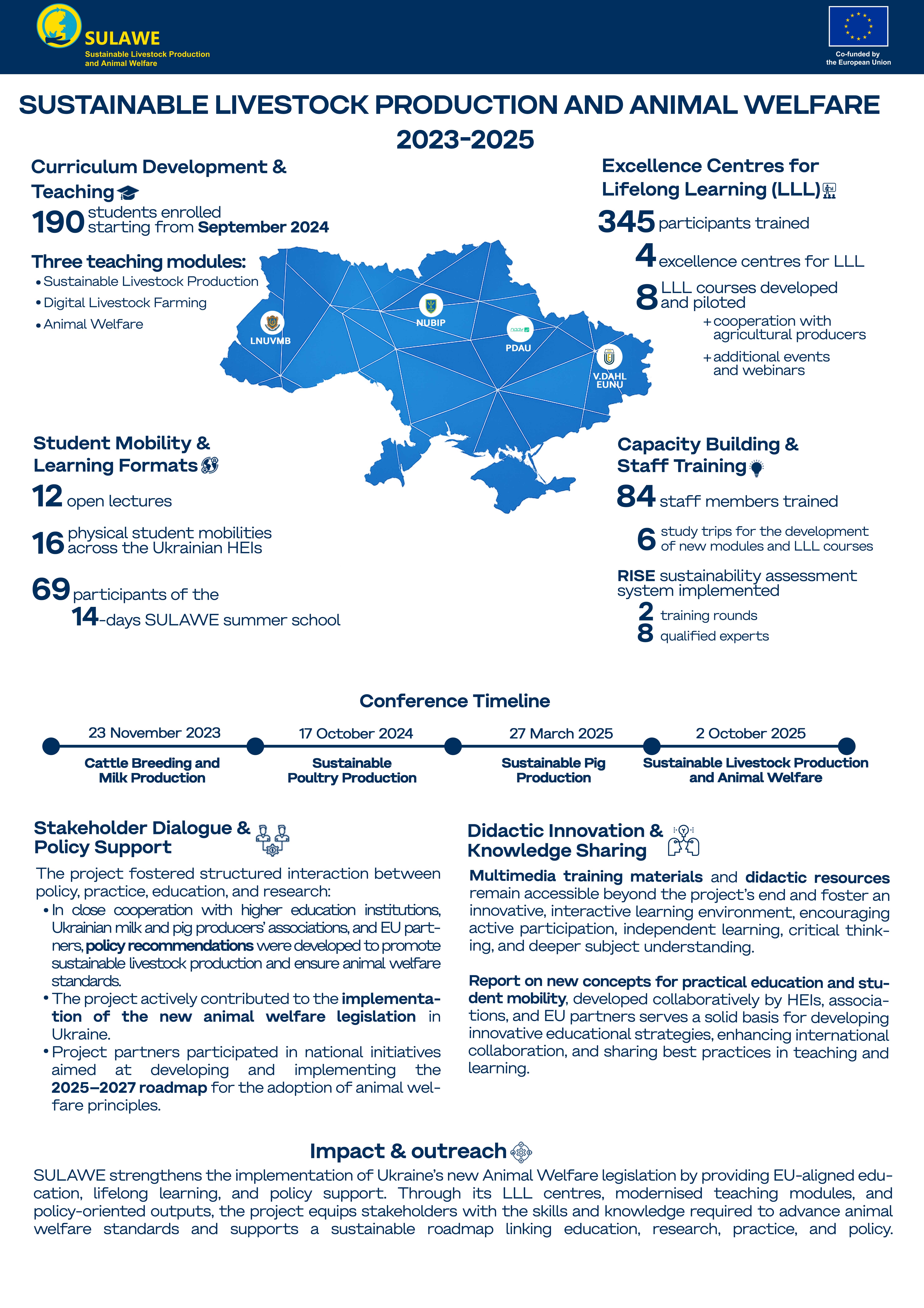
Over this period, the project achieved significant results in professional training and knowledge dissemination. In particular, 190 master’s students were involved in higher education activities, and since 2024 new educational modules on livestock digitalization, animal welfare, and sustainable production have been introduced.
At the same time, continuous professional development programs were actively expanded: 345 specialists participated in advanced training programs, 4 centers of excellence were established, and 8 training courses were piloted. The program also included close cooperation with farms as well as additional events and webinars.
Student mobility became another important component of the project. Within SULAWE, 12 open lectures were organized, 16 mobility programs between Ukrainian higher education institutions were implemented, and a summer school involving 69 students was conducted.
Special attention was also paid to stakeholder dialogue. SULAWE facilitated cooperation between educational institutions, businesses, associations, and international partners. As a result, recommendations on sustainable livestock development and animal welfare were developed, while the project also contributed to the implementation of new legislation in this field.
The project further contributed to the development of a roadmap for implementing animal welfare principles in Ukraine for 2025–2027 and supported the introduction of innovative educational approaches.
Thus, SULAWE became an important platform for sector transformation by combining education, science, and practice. The achieved results create a foundation for the further implementation of European standards, development of professional competencies, and improvement of livestock production efficiency in Ukraine.
The Erasmus+ international technical assistance project “Sustainable Livestock Production and Animal Welfare” (SULAWE) brought together researchers from Ukrainian higher education institutions — Stepan Gzhytskyi National University of Veterinary Medicine and Biotechnologies Lviv, National University of Life and Environmental Sciences of Ukraine, Poltava State Agrarian University, Volodymyr Dahl East Ukrainian National University, and the Scientific and Methodological Center for Higher and Professional Pre-Higher Education — as well as European universities, including Nürtingen-Geislingen University of Applied Sciences, the Swedish University of Agricultural Sciences, and the University of Ljubljana, together with industry business associations such as the Association of Ukrainian Pig Breeders, the Association of Milk Producers, and Tvarynprom.
During the implementation period of 2023–2025, representatives of the scientific community and the livestock industry had the opportunity to gain experience from leading European universities in training young professionals and improving the qualifications of livestock sector specialists.
The project is implemented with the financial support of the European Union. The views and opinions expressed in this publication are those of the author(s) only and do not necessarily reflect the views of the European Union or the European Education and Culture Executive Agency (EACEA). Neither the European Union nor EACEA can be held responsible for them.