





The restoration of tariff quotas between the EU and Ukraine and a substantial fall in prices for exchange-traded commodities led to a sharp reduction in dairy exports by Ukrainian companies. At the same time, imports of cheeses from Europe are growing.
According to preliminary data from the SSSU, in June 2026, 11.53 thousand tons of dairy products were exported for the amount of 35.06 million USD. Physical export volumes decreased by 23%, and monetary revenue fell by 31% relative to May 2026. Relative to June 2025, physical export volumes decreased by 7%, and monetary revenue was reduced by 23%. In January–June 2026, Ukraine exported 63.78 thousand tons (-10%) of dairy products for the amount of 180.87 million USD (-20%).
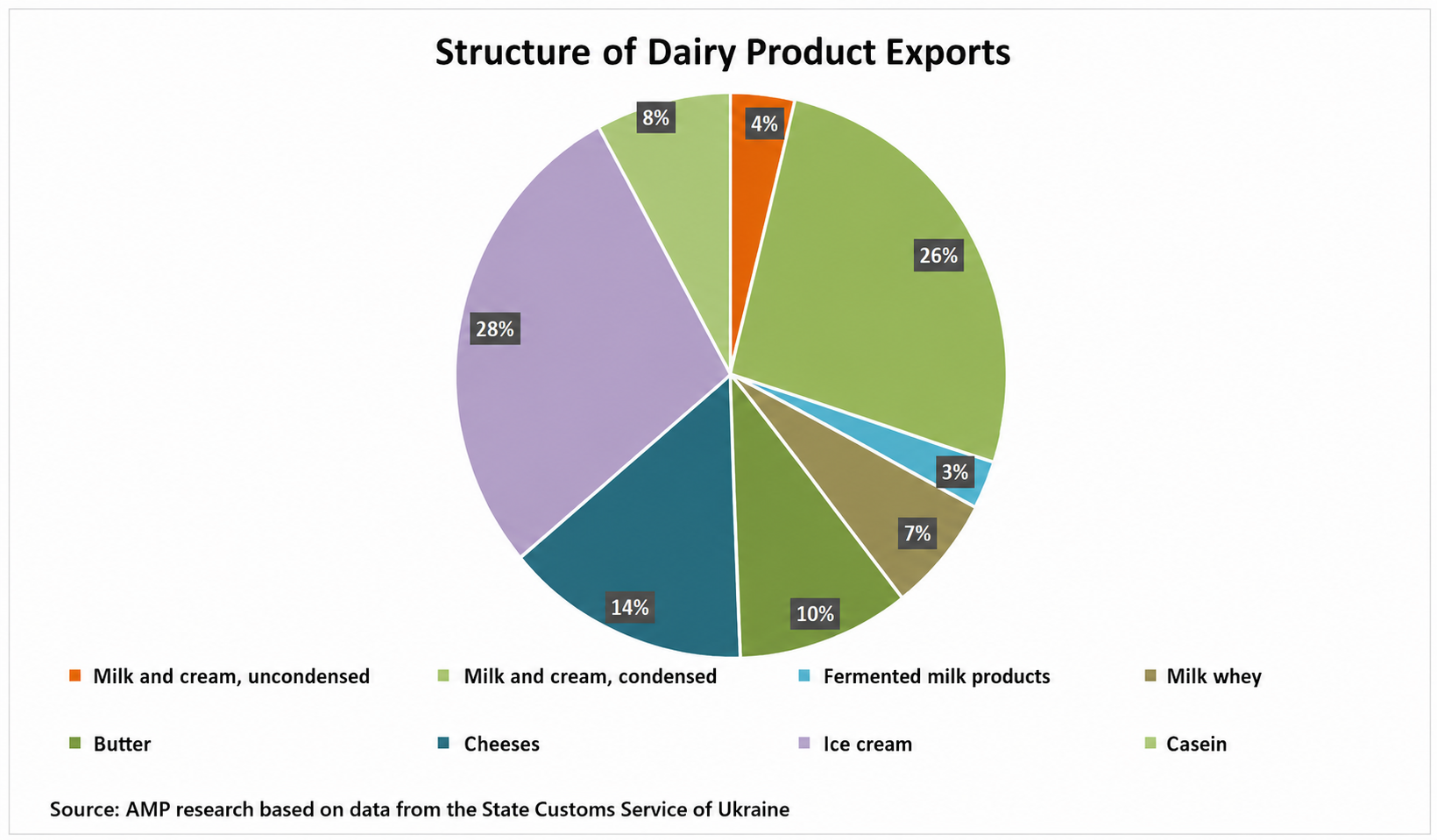
The main export categories were the following commodities:
- Ice cream – 28%;
- Milk and cream, condensed – 26%;
- Cheeses – 14%;
- Butter – 10%;
- Casein – 8%.
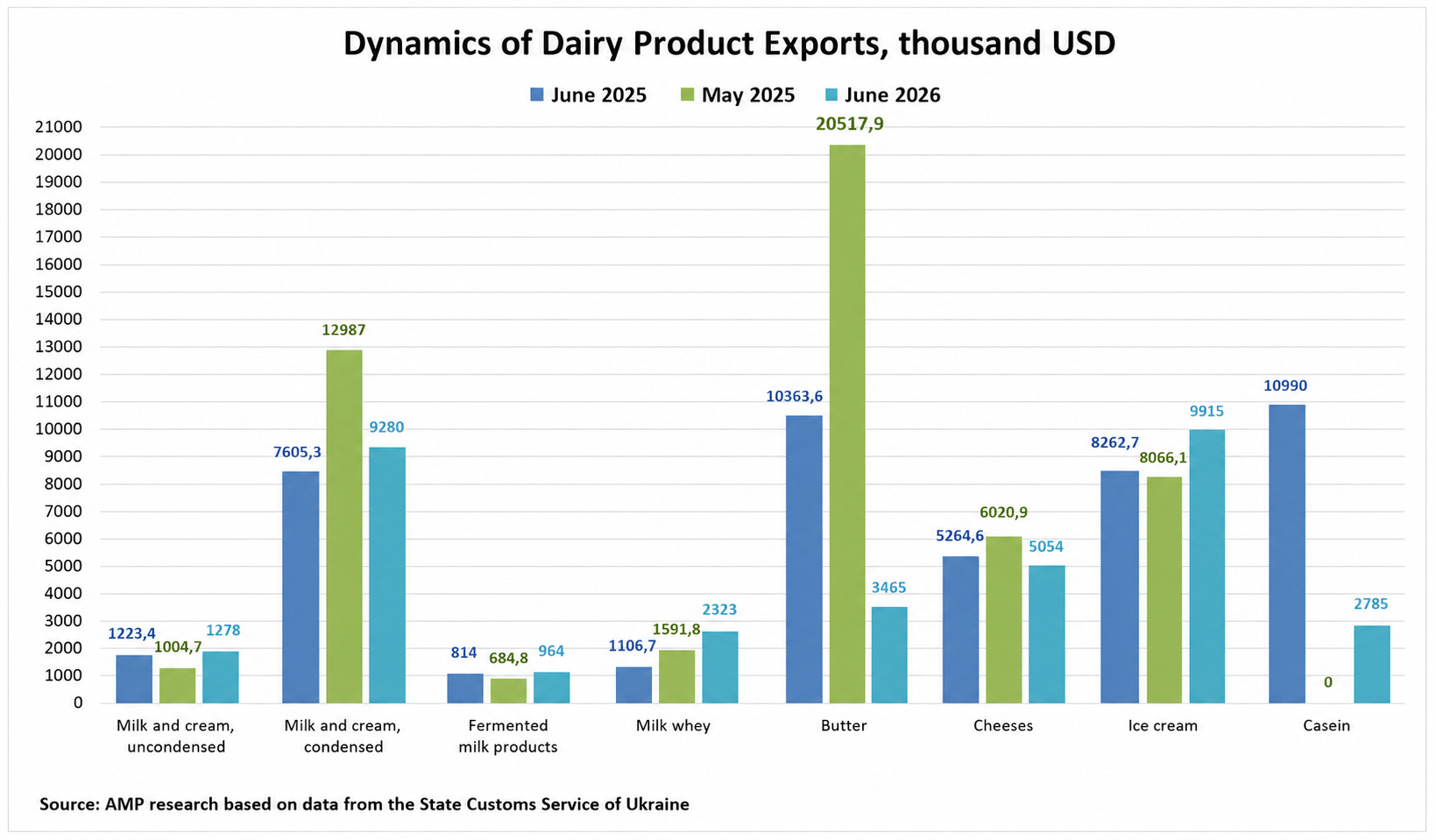
In June 2026, Ukraine increased physical export volumes of uncondensed milk and cream to 1.26 thousand tons (+6%), fermented milk products to 656 tons (+31%), and ice cream to 2.7 thousand tons (+21%), but reduced delivery volumes of other dairy products, including butter to 649 tons (-78%) and cheese to 1.08 thousand tons (-16%) relative to May 2026. Relative to June 2025, Ukraine increased physical export volumes of fermented milk products by 30%, ice cream by 20.4%, uncondensed milk and cream to 3.24 thousand tons (+8%), milk whey to 1.51 thousand tons (+32%), but reduced delivery volumes of other dairy products.
In June 2026, Ukraine increased export revenue for shipped batches of uncondensed milk and cream to 1.27 million USD (+27%), fermented milk products to 964 thousand USD (+41%), milk whey to 2.32 million USD (+46%), and ice cream to 9.91 million USD (+23%), but reduced revenue for other positions relative to May 2026. Revenue for exported butter decreased the most over the last month (-83%). Relative to June 2025, monetary revenue increased for shipped condensed milk and cream to 9.28 million USD (+22%), uncondensed milk and cream by 4%, fermented milk products by 18%, milk whey by 110%, and ice cream by 20%.
The restoration of tariff quotas between the EU and Ukraine and a substantial fall in prices for exchange-traded commodities, which has been ongoing since the second half of 2025, led to a sharp reduction in dairy exports by domestic companies. Low export demand for butter presses on milk prices, because of which the financial condition of most producers worsens. Butter and milk powder are the basis of Ukraine's dairy exports, but unrealized dairy products accumulate in warehouses. The market does not have time to absorb significant volumes of butter.
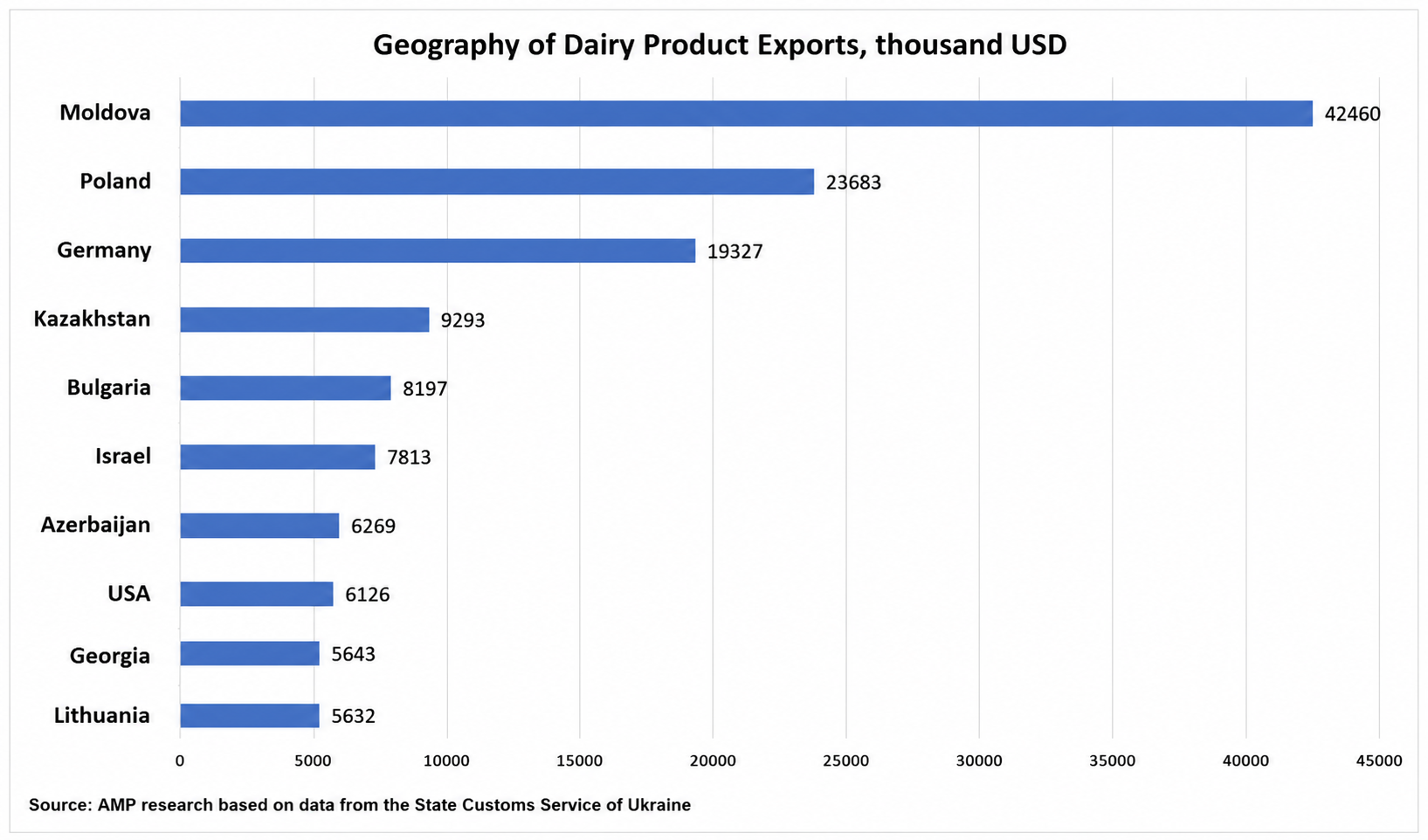
The main demand is formed in the countries of Africa and Asia, where the purchasing power of the population is relatively low, and dairy fats are forced to compete with cheaper vegetable counterparts. A return in the near future to the record butter prices that were observed in 2024 and the first half of 2025 is unlikely. A portion of companies with sufficient financial resources postpones product sales in expectation of a more favorable market environment, while others are more actively reorienting to the markets of Moldova and the countries of the South Caucasus.
One of the reasons for the reduction in deliveries is the introduction of quotaiton and licensing for exporters. The reason for low quota utilization for butter lies in a complex licensing mechanism, in particular in the need to make a deposit for financial guarantee of deliveries. Many European traders do not want to obtain licenses and set aside funds under the risks of non-execution of contracts.
The share of deliveries to the EU of non-quoted whey and fresh cheeses practically did not change. During 2016–2025, Ukraine increased ice cream exports to the EU, gradually strengthening its positions in the European market. Compared to 2016, when European countries purchased only 0.1 thousand tons of products for 0.1 million euros, exports in physical terms increased almost 100 times. The largest leap occurred in 2017 after the introduction of the free trade area.
In June, Ukraine increased dairy product imports to 8.68 thousand tons, which is 72% more relative to May 2026 and 95% more relative to June 2025. In January–June 2026, Ukraine imported 39.17 thousand tons of dairy products for the amount of 182.78 million USD. Physical import volumes increased by 30% relative to last year's period. The share of cheeses in total imports is 60%. The traditional reduction in population consumption of dairy products in summer is accompanied by rapid growth of cheese imports, which intensifies competition in the domestic market. Poland remains the main supplier of cheese to Ukraine. Significant volumes also came from Germany, the Netherlands, Latvia, and the Czech Republic. The situation is complicated by the price advantage of European producers. At the beginning of summer, the cost of so-called "feed" cheese in Europe decreased again, because of which the prime cost of importing block Gouda dropped. On this background, Ukrainian semi-hard cheeses with a higher selling price significantly lose to European counterparts in price competition.
To improve the sales of dairy products inside the country, protective measures are needed from the state against uncontrolled imports of dairy products from Europe, as well as countering unfair trading practices of retail networks. Increasing state procurement of domestic dairy products, including for the needs of the Armed Forces of Ukraine, should revive demand in the domestic market.
The foreign trade balance in June 2026 was negative and stood at -2.37 million USD.
Press service of the Association of Milk Producers
Follow us on LinkedIn
Related News: